#hiddencrisis: Biggest ever charity tweet chat

Tomorrow, Wednesday 15th February, Save the Children will host the biggest ever charity Twitter Chat on the #hiddencrisis .

I will be hosting the first hour of the tweetchat with @Nicole_Cardinal via @savechildrenaus account where we will be chatting to @MarionsKitchen from 4.30pm. Exciting. We will be talking about the importance of nutrition.

As food prices continue to rise mothers in many countries around the world are being forced to cut down the quality of food they feed their children; tomorrow ministers, academics, inventors, TV chefs, campaigners and mums will discuss malnutrition, the #hiddencrisis that is killing 300 children every hour, every day.

Hosted by Save the Children in collaboration with the United Nations Foundation, World Health Organisation  and The Million Moms Challenge, the Twitter Chat marks the global launch of their new flagship nutrition report, A Life Without Hunger: Tackling Child Malnutrition.

The Twitter chat, biggest ever attempted by a charity, will last 12 hours, spanning 3 continents and 12 different time zones starting at 4.30pm EST.

Other participants on the tweet chat will include:

  • Agnes Binagwaho, Rwandan Minister of Health: @agnesbinagwaho
  • Dr Stanley Zlotkin, inventor of sprinkles micronutrient powder: @Stantheironman
  • Jeffery Sachs, Economist, Professor, Special Advisor to UN Secretary-General. Author of The Price of Civilization: @jeffdsachs
  • Sara Ziff, New yorker, model, filmmaker, community organizer: @saraziff
  • Kunal Kapoor, Bollywood star: @kapoorkkunal

Use the #hiddencrisis hashtag to participate and join the conversation.

To make it easier to keep track of the conversation and the schedule for each session, pop over to the tweetchat chatroom
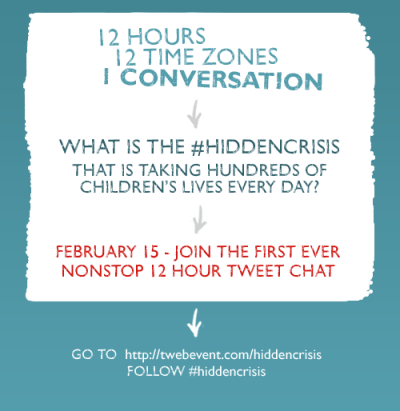
 http://twebevent.com/hiddencrisis

Animals rule the media

I like dogs. I think they are cute. And I do feel sad when I see one with a muzzle and a chain around its neck and that sad, slightly tilted head and wilted eye look. But when it comes to both traditional and social media I struggle to see why the rights of dogs often gain more attention that the rights of humans.

The front cover of the age on Friday showed a half page picture of a genuinely deprived and mis-treated animal, with the accompanying title ‘At one Melbourne property, this was a dog’s life… Until its rescue last night’. This article was followed by a mention of ‘100 people still missing as PNG ferry sinks’. Interesting.

Not sure if I find it more disappointing that this is what sells in our society or this is how the media outlets select to prioritise.

Animals get social too.

The interest and activity around the promotion of animal rights is not limited traditional media. Research done by craigsconnect at the end of last year showed that organisations promoting animal related issues gained more traction on twitter and Facebook than any other organisations – such as those associated with emergency relief, children or health. Given the real time nature of social media and the ability to immediately share first-hand experiences, the platform naturally fits with an organisation related with human issues and emergency relief organisations in particular. Regardless it is still the animals that come up trumps.

Animal abuse is easier to talk about.

Maybe issues related to animals gain media attention because they are emotionally engaging and also comprehensive and solvable. Even the hard hitting cases are easier for most of the general public to discuss, understand and create a fairytale ending (animal activist free’s dog from illegal abattoir). Issues related to human beings can be confronting, overwhelming and make an individual feel powerless to make an impact (100 people missing as a boat sinks off PNG).

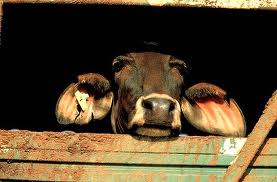
Animal rights are important. And I do like dogs. But how important should be questioned when one dog gets prioritised over 100 human beings and numerous other worldly issues. This is similar to what I mentioned in a blog post last year in regards to why is it that so much more public outrage occurred in response to the treatment of live cattle being exported to Indonesia, compared to the deporting of people to Malaysia under the Gillard government’s refugee swap scheme.

Why is it that animals continue to rule the media?

Perhaps it is a combination of ignorance, confrontation, and the insolvability of the human related issues pitched against the persuasive power of the puppy dog eyes. What do you think?

The future of the business card

I love the idea of digital networking. Nothing is worse than the old business card swap, especially when you’re on the receiving end of an early 90’s photo card. The people over at Linkedin are reveling in the Card Munch App. It is an app that scans business cards, records the information onto a digital card and matches details with the users linked in profile. Showing extra info such as education, previous roles and recommendations. Handy. But I do feel a little lost about this app. I see that it is bridging the gap between yesterday and today’s networking world. And something that is equal to 4 tonnes of paper and saves 67,348 consumer hours (according to PSFK blog post) has to be good right? Card Munch is munching through traditional business cards and turning them into digital recorders. But why bother to do the business card transaction in the first place?

Ideally I would only need a solo business card on a lanyard around my neck for easy scanning access. Everyone has their scan and voila we are connected. If I was a conference organiser my next batch of willing participants would get their business card details on a cheap lanyard and happily scan their way to network heaven. So that we do actually save the 4 tonnes of paper.

But I am not a conference organiser and oddly I don’t feel like wearing my business card around my neck just for kicks. So I will just download the app, add the stash of business cards in my bottom drawer to the 2 million already scanned and wait patiently for business cards to quietly hand over their networking reigns.

http://www.cardmunch.com/


graph via PSFK: http://www.psfk.com/2012/01/digital-business-cards.html#ixzz1jgb0e94t

5 things I learnt last week at the workshop for innovation and entrepreneurship

Last week I participated in the Workshop for Innovation and Entrepreneurship. Run by Deakin University it was based on the successful Danish workshop and the first time one like this was run in Australia. The theme was sustainability. It was a week full of speakers, problems solving, mental and emotional challenges and competitive innovation. Super.

Each group was presented with an industry problem. Mine – to reduce the amount of stand-by power in Australian households using motion sensor technology. Some others included; increasing the efficiency of the Victorian regional rail system, increasing the financial stability of the RSPCA, and improving the sustainability of Deakin University.

Like every group we had a mix of backgrounds, skills and experience (think a PhD in Robotics, crossed with 5 years running confectionary factories and a Masters in International Development). After numerous rounds of perfecting an idea, breaking it and then throwing it out we finally found something that ticked, rolled, landed on its feet and won. I wish I could share it – but we are currently looking into patents… so stay tuned 🙂

So instead…. here are 5 things that I learnt from 5 days in a mixing pot of innovation and entrepreneurship:

1. Don’t be selfish with good ideas

Sometimes you think that you have an idea that is so good you don’t want to risk someone stealing it.  Well, nothing is good if it goes unshared. Concepts grow, manipulate and get stronger with every adaptation.

2. Leverage, leverage, leverage.

The best ideas usually already exist in some form. Take something, make it better, put it in a new environment and it will grow.

3. The horizon of the public consumer is limited

A sad realisation. But sometimes a great idea is just too different and forward thinking to be accepted in the public domain.

4. Animation in powerpoint is still cool

Explaining a motion detection system that switches between controlling the powerpoints in your home and your security system was made simple with some good old animation. True.

5. Black and brown make me frown

Never use a dark brown background with black writing for a presentation. The audience must be able to easily read the content of the slide. Simple. Yes. But three presenters used colour schemes that made reading their slide content like following a breadcrumb trail in the Sahara. Not a good idea.

One day in the life of the world: The 11 Eleven Project

Would it be possible to document one day in the life of the world?

Not just my day, or your day, but a day in the world. It almost makes my brain hurt. Imagine capturing every culture, every language, every religion, every taste, every smell, every conversation, every argument, every journey, and every sneeze. All in a nice little package. An undeniably big task and perhaps an insurmountable challenge, but how amazing would it be? And that is just what The 11 Eleven Project is attempting to do.


When the ones align, there is one chance, to document one day, in the life of one world.

The 11 Eleven Project will commemorate the 11/11/11 by collecting and collating footage from all over the world. For 24 hours, anyone who has access to a film, video or digital camera, microphone, mobile, or email is asked to create a day in the life of their world and send their footage in. This will then be edited into a documentary, a music album, a photo story, an iphone app and an online resource. A story will be told about what happened in the world on the 11/11/11 and you can be part of it.

The perfect use of digital technology and the internet.

Bridging the geographical, cultural, ethnic and religious boundaries to document, realise and celebrate our similarities and our differences and to find out what unites us as human beings.

Happy snap your way through the 11th November and support this collaborative project. Your sneeze could make the final cut.

Find out more over here.

If you were a colour, what colour would you be…

Nothing like a simple, interactive campaign with small, set donations where you get something back to engage the masses. The new ‘Own a colour’ campaign by UNICEF and Dulux does just this. For one pound, you can purchase and name a colour. The money raised goes to UNICEF and they are aiming to name all 16.7 million colours. So far the money raised is just over £70,000.

Although it is more about getting to name a colour after your dog than giving money to UNICEF, it is great to see an innovative partnership.

The title ‘own a color’ sells the personal benefit, not the humanitarian one.

But there is nothing wrong with this. People are tired of hearing ‘save a life’, so tapping into the I-get-something-back mentality makes it work. There is an underlying connection of missions – Dulux ‘add colour to peoples lives’ and this campaign allows you to add colour to a child’s life. Nice. Check it out over here.

And the infographic says…. today is a good day online

Ah infographic. I wish to publicly declare my love for you.

The way you visually represent stats and pump life into data that would look so boring in excel or powerpoint is admirable.

And if there are things to click on, scroll over, flip and expand that is even better.

So check out this infographic. It shows the state of the internet – the growth, the reach, the income, the trends…. and was produced by our friends over at Online Schools .

Little snippets of info include:

  • 71% of the people in developed countries are online, only 21% of those in developing countries have access so far
  • The internet is a legal right in countries like Finland, Spain and Estonia. Countries like Egypt and Turkmenistan on the contrary are Internet black-holes, where online access if highly censored.
As I said above dot points just don’t do information justice these days, so pop below and click, scroll, expand and flip to your hearts content (there is even an internet mood poll – which tells us today is a good day online… phew).

State of the Internet 2011
Created by: Online Schools

Child sponsorship: Off the shelf vs lucky dip.

Child sponsorship in theory is a great concept. A one-to-one relationship between the donor and the child. The ability for the donor to feel like more than just another dollar, and to see that their support alone is making an on the ground difference. Most people do now understand that the money does not go directly and only to the child, but instead to the community that supports them. Even with this knowledge, the process of sponsoring a child still gives people a sense of control over where their donation is going and an emotional connection with the child.

Child sponsorship is an income engine for development organisations. It strikes an emotional chord with potential donors, more so than program or emergency appeals. Behind the big brown eyes of the chosen child the money does get pooled and spent on community projects.

However, I have always struggled with how child sponsorship is portrayed to the public. In short, how the child is ‘marketed’ to a potential sponsor. A crass word to use when relating to supporting children who do genuinely require help, but a concept that must occur for these children and their communities to receive the support they need.

What level of ‘marketing’ is required and acceptable to encourage people to sponsor children?

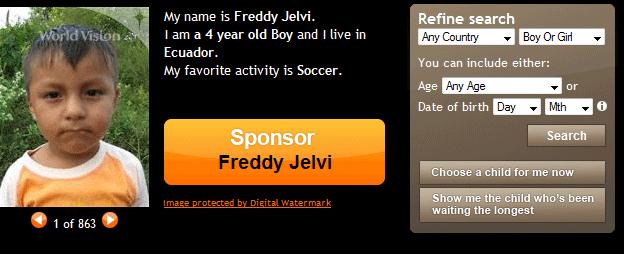
Is it wrong to have all the pleading faces lined up on your computer screen so that you can flick through and select the cutest one with big brown eyes? Or is this a level of engagement that is necessary for the people who are attracted to child sponsorship to get that feeling of connection and control?

Is it natural to want to ‘see before you buy’?

Being able to choose the jacket in red over the jacket in blue. Even though you know they are the same design from the same material, but for no particular reason you just like red better. It is horrible to compare child sponsorship to online shopping. But people do have preferences. Even good people who want to sponsor children who do need their help. When committing to handing over money every month it is only natural to want to see what your money is going towards.

Lucky dip.

Some organisations do offer child sponsorship in absence of photos and information about the child. People choose to sponsor an anonymous child for $42 per month and only after the credit card details are entered the donor is allocated a child to sponsor. Thus removing the meat-market pre-purchase scenario (and the horrible risks associated with having photos of children online) but at the same time also removing the choice and control over where the money is going and the selective one-to-one relationship which is unique to child sponsorship. Does this un-marketed version still provide the same level of incentive to sponsor a child? If you do not see photos of the child and do not engage ‘pre-purchase’ are you still as likely to sponsor the unknown child?

So many questions and a personal moral dilemma.

For an organization to run sustainable long-term programs it needs a reliable income flow – which child sponsorship provides and I understand. In a bid to increase this income an online shelf of pleading children drives a higher level of emotional engagement and hence more donors. But to what point is it ok to market these children online? Should we just take the blue jacket, hand over our money and put the choice of where our dollar goes into the hands of the experts and bypass child sponsorship altogether. Yeah probably.

Yes. Raquel makes #GoBackSBS and we made the radio.

Yesterday we suggested that Go Back to Where you Came From becomes compulsory viewing for all Australians. That one of the biggest issues fuelling the ‘boat people’ debate is the lack of education. Through mainstream programming of the show it has the ability to humanise asylum seekers and give the public real insight into what it means to be a refugee.

The post generated a sea of chatter and yesterday afternoon we were contacted by 720 ABC Perth to discuss the idea of compulsory viewing and the interest #GoBackSBS is generating online.  @BryonyCole did a stellar job and you can listen to her interview over here.

The strength of the show lies in the mix of the characters.

As much as we may not like to admit, this handful of Australians does well to represent the majority. My brother summed it up superbly.

“At least Raquel stands by her convictions unlike the other wind socks who are shedding a tear with the refugees one minute then chasing them out of the bushes with batten yielding immigration police the next. Raquel is pretty full on and a bit of a sissy, but she is the only honest one there and is spot on with her comments regarding fixing the problem at the source. She does more for the show by raising the points she does in the way she does, although they may be difficult to swallow.”

Although where was Raquel in the ads for tonight…

Go back to where you came from: Superb, uncomfortable & influential (?) viewing.

Go back to Where You Came From last night was fantastic viewing and should be compulsory watching for all Australians. Superb work by SBS. But just how much impact can the show have without the reach of commercial television? After the three nights of the show are done will there be an outcry like was seen over live animal exports. Unfortunately, highly unlikely.

Would you send me back?

As mentioned on a blog post published by UNICEF last week – Why is it that so much more public outrage occurred in response to the treatment of live cattle being exported to Indonesia, compared to the deporting of people to Malaysia under the Gillard government’s refugee swap scheme?

One of the biggest issues is ignorance.

There is a definite lack of education. Which was clearly illustrated last night. How do people know if they don’t see.

Did you know that in 2010, Australia accepted 0.03% of the world’s refugees, asylum seekers and displaced people; of the 43.3 million refugees globally, we took just 13 750.

Go Back to Where you Came From is creating superb uncomfortable viewing that has the ability to humanise asylum seekers. Lets just hope that a commercial channel picks up Go Back in the near future so it reaches the minds of the masses that need to be educated.

Everyone loves a little test.

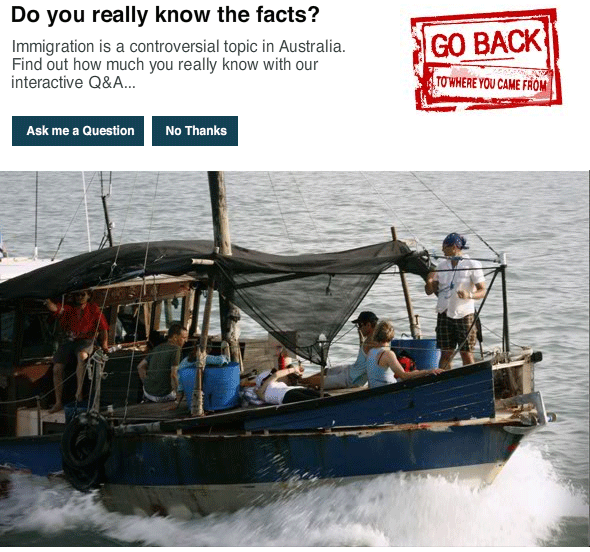
In the meantime send some mates who need a little education on the issue this great interactive Asylum Seeker fact tester which lives over on the SBS website. Also if you missed last night you can watch it here.

Finally, if you had fled war, terror, starvation… would you go back to where you came from? Highly unlikely. And do you think Raquel will survive her experience in Malaysia? Again, highly unlikely. Great viewing tonight indeed.