Twestival Tomorrow.

Tweet. Meet. Give.

What better way to use your love for online than to head down to your local twestival event.

This year Twestival is going ‘Local’ in cities around the world tomorrow, Thursday 24 March 2011. Events for Twestival Local will raise funds and awareness for local nonprofits that organizers identify for having an incredible impact within their own community.


Vegan Month

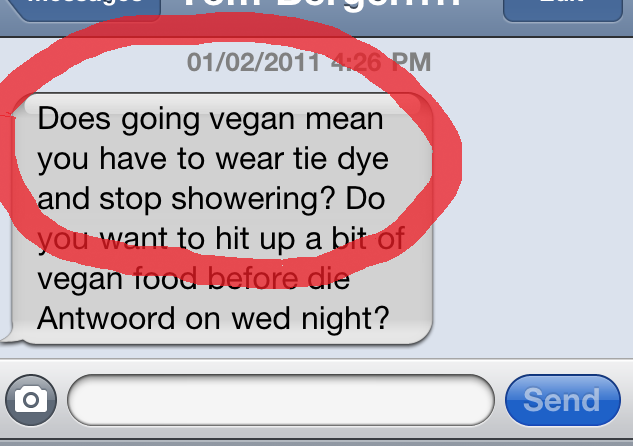
When I told friends I was going to try a vegan diet for February, the response was often:

Signing up for Vegan Month however, is about much more than wearing flares and cutting out eggs and sausages.

The brainchild of fellow Awesome Foundation Board Member Xavier Shay, Vegan Month is an immersive course which utilises small-scale communities, social media and mini-tasks to involve and educate its participants.

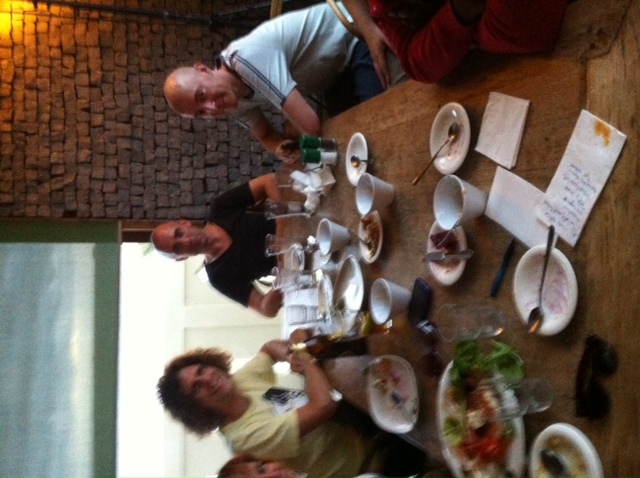
Weekly Vegan Dinners: Week 1, Soul Mama's St Kilda.

I managed to grab Xavier for his take on the program after dinner this week…

For more information, hit www.vegan-month.com

Follow Feb #veganmonth adventurers on Twitter:

If I could change the world this year…

Emerging from the food & beverage coma that is Christmas and New Year I am feeling inspired for the year ahead. Thanks to @davidahood and the instigation of the social change collaboratory &  this TEDx Talk by Peter Grzic from Oxfam, the following three questions have been circling the runway inside my head:

What do you care about?

What do you want to see change?

And…

What are you going to do about it?

I care about respect – for each other and the environment. I saw a guy get beaten up in Chapel st last night, and a man throw a cigarette butt out the window. I want this to change. So as my plans come to fruition for how I am going to positively impact those around me in 2011, and words like  ‘masters in international development’, ‘hablar mas espanol’, and a ‘worm farm on my balcony’ continue to circle in my head, what are you going to do?

In the words of Margaret Mead, “Never doubt that a small group of thoughtful, committed citizens can change the world. Indeed it is the only thing that ever has.”

Got Awesome?

Got an awesome idea? Yeah you do!

Need help getting it up?

Enter the Awesome Foundation; a monthly grant of $1000 awarded to people doing something awesome, no strings attached.

Sprouting roots in Boston a year and a half ago, the foundation works by distributing monthly grants of $1000 self-funded by local groups of ten micro-trustees to ‘awesome projects and their creators’.

Awesomeness? What does an awesome idea look like?

How about a hip-hop word count? HOLLA!

Giant hammock? Check.

Do you like robotic lamps? Yes please.

If previous projects are an indicator, awesomeness is not limited to any one industry or purpose; from community farming initiatives to hip hop linguistic tools, a diverse array of projects got a nod from the Foundation this year.

Most recently, the Berlin chapter announced their first winner to build a sleigh track for the whole community, a “Wilde Schlittenfahrt”, a wild downhill sledge ride.  HOLY AWESOME!

Wilde Schlittenfahrt aka Wild sled ride – Awesome Foundation Berlin grantee Konrad explains his idea from Henrik Moltke on Vimeo.

Boston’s concept has rapidly grown wings with an international alliance of chapters committed to ‘sustaining and promoting the interest of Awesomeness’ across the globe. Next stop, Melbourne.

I’m pumped to be joining the Awesome Foundation trustees on the Melbourne adventure, who knows what 12 awesome projects will be supported in a year’s time?

Outside Melbourne, The Awesome Foundation chapters can be found in Berlin, Boston, London, Los Angeles, New York City, Ottawa, Providence, San Francisco, and Washington, DC.

Make sure your awesome idea is put up for consideration and apply. Chances are, there is an Awesome Foundation near you.

FAQ – The Awesome Foundation.

Keep updated on The Awesome Foundation Melbourne Twitter with @awesomemelb & their trustees.

Try to DoGood and you fail.

DoGooder done and dusted.

DoGooder was a plug-in for your browser that replaced traditional ads on the websites you visited with ads that raised money for good causes.

Sounds great.

As GOOD put it so eloquently in a post written earlier this year:

Which messages would you rather see while you were browsing online?

Buy a Chevy Malibu! Get the New American Express Gold Card! Watch the Real Housewives of New Jersey on Bravo! Eat ReddiWip!

Or:

Ride your bike to work. Support urban farms. Fertilize your garden with used coffee grounds. Donate your old phone. Pee in the shower.

But after just over a year of business, the Canadian company, DoGooder posted their final blog post and announced “it’s been a good run, but today we are shutting down our service indefinitely.”

It was an interesting idea. To swap ads that a visitor sees on a website so they are presented only socially-minded advertising. They aimed to give 50% of their profits to charity, and keep the other 50%. Sounds like a feasible business venture. But they needed a large network of people running their plug-in to attract the advertisers, and make the business profitable. Unfortunately the demand was not there, and in the end it was lack of income that resulted in the network closing.

Why did people not use DoGooder?

–       Felt they were stealing income from the site owners (by switching out ads, the income that would have been generated from click-throughs on the original ads would now go 50% to DoGooder and 50% to charity).

–       Too hard.

–       People like bad online advertising.

Whatever the reason, it is sad to see a charity supporting, socially-minded online business shut it’s doors.

If you didn’t have to do much, to do some good, would you? Hint: It would have taken 10 seconds and it was free.

Would you have used DoGooder?


The Chinese Twitter Jailbird.

This blog is usually a platform to voice all the positive ways that the online space is being leveraged to benefit society.

But @Melbourne_Muz brought this case of twittersphere injustice to my attention last week.

A woman in China was sentenced to a year in a labour camp for re-tweeting a message encouraging nationalist protestors to destroy Japan’s pavilion at the Shanghai Expo. (Check out the BBC article over here). Apparently her message was intended as a joke – but the Chinese government did not see it so.

As the BBC points out – this is a true example of how closely twitter, and all content online in general, is monitored by the Chinese government.

As the power of social media grows, so too must their worry and concern over how to control the individual voices & opinions it carries. An interesting space to watch indeed.

Hip-hop the vehicle for the Burmese voice of freedom?

The first generation of hip hop in Myanmar hit the streets in the early 90’s, via the beats of Acid.  A group of 4 guys who shifted a music scene that had been suffocating in Rock n’Roll for decades. They simultaneously provided a black market vehicle to voice political dissent for the youth of Burma.

The traditional structure of the Burmese society combined with the 50yrs of military rule are not a natural environment to embrace hip hop and the voice of freedom it carries.

Song lyrics are vetted by a censorship board for anti-government sentiment prior to being recorded, performances are regularly banned and artists have been arrested on political charges for being associated with the hip-hop scene. In short, avenues for music distribution are limited.

Enter the interwebs.


Thxa Soe – one of Burma’s leading hip-hop stars – and the underground group Generation Wave challenge the restrictions of the ruling military junta. An interview with Thxa Soe published in The Guardian earlier this year explains how he skates close to the edge of what is acceptable in the junta’s eyes, and his songs are regularly banned. The song titled ‘Water, Electricity, Please Come Back’ — an obvious comment on Rangoon’s inconsistent power supply — was forbidden. On a recent album, eight of the 12 tracks were forbidden. With bootleg copies of the album regularly seized by police, internet is the best medium of distribution. Even with limited and regulated access, the internet has helped spread the political messages wrapped within the beats of hip-hop.

Thxa Soe told The Guardian that he has chosen to stay in Burma, despite the risks, because he sees his voice as important in his homeland:

“It is very difficult being a musician in Myanmar. You are not free. You are always being watched, for what you say, and you are being told what you can say and what you cannot. [But] I believe music can change a country, not only our country, but the whole world.”

Links:

http://en.wikipedia.org/wiki/Burmese_hip_hop

http://www.mizzima.com/news/inside-burma/1512-detained-hip-hop-singer-yan-yan-chan-released.html

http://www.guardian.co.uk/world/2010/apr/22/burma-hiphop-resistance

http://en.wikipedia.org/wiki/Burma

http://www.guardian.co.uk/world/video/2010/apr/23/burma-hip-hop-challenge-junta

Is sharing the new currency?

You have it, you can share it. You need it, you can borrow it. Office space, accommodation, cars, books, videos, bikes, presentations, handbags, appliances…

Has all this real world sharing been sparked by the online sharing that is now second nature?

A study released last week, The New Sharing Economy, by Latitude Research and Shareable Magazine, was prompted by the surge in sharing startups driven by social technology.

“The rise of sharing requires us to use a new language where ‘access’ trumps ‘ownership’; social value becomes the new currency; ‘exchanges’ replace ‘purchases’; and people are no longer consumers but instead users, borrowers, lenders and contributors. All of this means businesses must redefine their role from providers of stuff to become purveyors of services and experiences,” says Neela Sakaria, SVP of Latitude.

The study found that people who were sharing online were also more likely to share physical items such as dvd’s, bikes, cars & books with strangers.

But this correlation does not necessarily transfer to an offline to online cause relationship. Perhaps people who are more likely to share in real life are encouraged to head onto the interwebs and share away. Rather than the online sharing activities “spurring” more offline sharing.

Or perhaps ‘sharers’ share wherever they happen to loiter – bookcrossing.com or Prahran library – and with an increase in social technology the opportunities to engage in sharing activities are everywhere.

In short. There is more sharing. Don’t fight it, just share it.


The subconscious education of public taste

I was in Paris a couple of weeks ago and was lucky enough to spot a guy mid ‘paste up’ – in the process of posting art – while hanging out at Centre Pompidou.

It just so happens I’d bumped into Eric Maréchal, the founder of a global art project,  Street Art Without Borders, which connects artists with volunteer ‘pasters’, through the power of social media.

Eric @ work

The idea is simple, using Flickr, Eric  finds artists who he admires, contacts them and offers to paste their work up in whatever city he is in.  They send him the works, he pastes them and posts pictures of it back up on to Flickr.

“The fascinating part of that work is also the exchange with the artist, their story, their unique message to the world.”

Many of the artists, he tells me, have never done any street art before.

Artists that traditionally work on canvas or other mediums, find a new way to express themselves and reach a different audience.

Eric, who goes by the name of ‘urbanhearts‘ online, showed me a work by a Chinese artist who he discovered on Flickr.  It was the first time she had done street art, and experimented with local newspapers to paint on, which aside from being easy to post, look incredible.

If you believe that street art has the power to improve well-being, then you’d agree this is one project using social media for good.

To tear the street away from the grey and dreary monotony of neat rows of buildings; to throw a firework of colours into its midst, joy radiating outwards, to convert walls and basements into surfaces to be decorated, and from this wind-exposed museum to deduce that which reveals a race’s personality, and at the same time, the subconsicious education of public taste.

– Preface to the Jules Cheret (France’s first street poster artist) exhibition catalogue at the Theatre d’Application, 1889 in Paris.

Paris 1889 – Jules Cheret                      Paris 2010 – Zhe155

Related Links

iSchoolyards: kids + tech = awesome

On Monday primary school kids from across Australia gathered at the State Library of Victoria.

The tweenhood from Northern Territory to Tasmania – “our future’s leaders” – came together in Melbourne for one hot topic: digital learning.

From all accounts you’d think they’d been invited to have playlunch with Justin Beiber, the excitement and enthusiasm was that palpable.

The event, ‘Listen2Learners‘ was the anti-thesis to the classic isolated, socially awkward child oft portrayed when we pair kids + technology.

Students showcased a range of awesome projects, from running their own radio station to preparing a cybersafety program for incoming primary students.
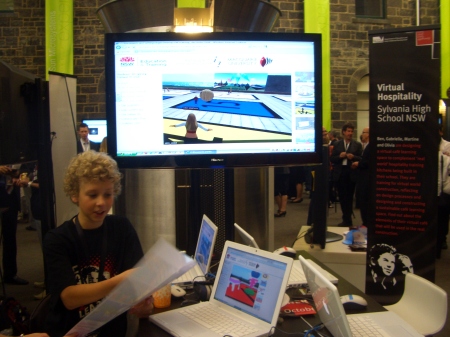
 

photo credit: Tania Sheko


The audience, a mix of business, government and community sector listened on as the kids demoed their creations.  Many had to submit applications for their ideas, and defend their concept against the ‘tough questions’; all processes that exist in my ‘grown-up’ world at work.   Learning to think critically through ideas to creation is a valuable lesson to be learning so early in the game.


Photo credit: Tania Sheko


Funnily enough, an old primary school bud Caz Pringle over at ThinkTank Media wrote a post this week which paints a drastically different image of kids increasing use of technology, the dark side…empty playground swings and a growing spawn of fat, geek kids.


A whole generation of Cartman's?

Could we be incubating a whole generation of Cartman's?


Considering Caz is a fellow Gen-Yer and grew up with the big bad Internets, it’s a surprising and provoking change to hear this side of the coin voiced from someone so well-versed in the WWW. (It’s inspired this post in response, I didn’t make it to the Listen2Learners but I was determined to provide some quality social education examples to alleviate the anxiety of picturing a generation of South Park’s Cartman’s IRL…)

Back to the happy, glass-half full juice.

I’d like to think the future is in good hands. Moreover, we better recognise the present is already in the hands of 7 year olds.

My favourite example was kids from Prospect Primary School who became teachers, and schooled their ol’ teach and 69 other teachers in how to make movies.

Using their experience in making films about animals for ‘zoo-tube’, these students set a challenge for adult learners – to learn movie making from scratch in order to make a one minute movie in one day on location at the Adelaide Zoo.*

Empowering and valuable learning for the kids right there….and, Zoo-tube!

These kids are so cool for school.

Links